

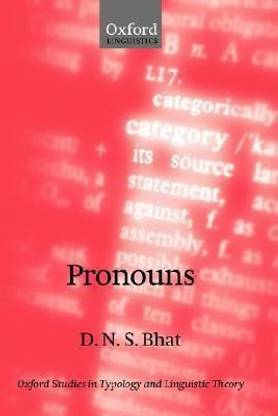
Pronouns (English, Hardcover, Bhat Darbhe Narayana Shankara)
Share
Pronouns (English, Hardcover, Bhat Darbhe Narayana Shankara)
Be the first to Review this product
₹3,799
₹3,800
Available offers

T&C
T&C
T&C
T&C
Delivery
Check
Enter pincode
Delivery by6 Dec, Saturday
?
View Details
Highlights
- Language: English
- Binding: Hardcover
- Publisher: Oxford University Press
- Genre: Language Arts & Disciplines
- ISBN: 9780199269129, 9780199269129
- Edition: 2003
- Pages: 332
Services
- Cash on Delivery available?
Seller
Description
On the basis of a cross-linguistic study of over 250 languages, this book brings to light several fascinating characteristics of pronouns. It argues that these words do not form a single category, but rather two different categories called 'personal pronouns' and 'proforms'. It points out several differences between the two, such as the occurrence of a dual structure among proforms but not among personal pronouns. These differences are shown to derive from the distinct functions that the two categories have to perform in language.The book also shows that the so-called interrogative pronouns of familiar languages do not actually have interrogation as their meaning. One can only assign the meaning of indefiniteness to them. Further, the notion of indefiniteness that can be associated with these and other pronouns is quite different from the one that can be associated with noun phrases. Other interesting aspects of this book include the postulation of certain typological distinctions like 'two-person' and 'three-person' languages and 'free-pronoun' and 'bound-pronoun' languages.
Read More
Specifications
Book Details
| Imprint |
|
| Publication Year |
|
Series & Set Details
| Series Name |
|
Dimensions
| Width |
|
| Height |
|
| Length |
|
| Weight |
|
Be the first to ask about this product
Safe and Secure Payments.Easy returns.100% Authentic products.




Back to top