

Get notified when this item comes back in stock.
Share
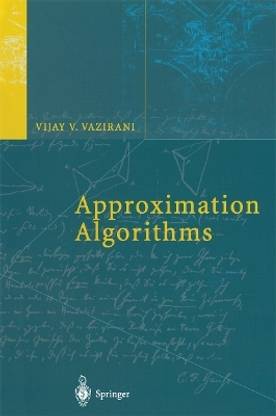
Approximation Algorithms (English, Paperback, Vazirani Vijay V.)
5
2 Ratings & 1 ReviewsSpecial price
₹3,138
₹3,436
8% off
Sold Out
This item is currently out of stock
Highlights
- Language: English
- Binding: Paperback
- Publisher: Springer-Verlag Berlin and Heidelberg GmbH & Co. KG
- Genre: Computers
- ISBN: 9783642084690, 9783642084690
- Pages: 380
Seller
Description
Most natural optimization problems, including those arising in important application areas, are NP-hard. Therefore, under the widely believed conjecture that P?NP, their exact solution is prohibitively time consuming. Charting the landscape of approximability of these problems, via polynomial-time algorithms, therefore becomes a compelling subject of scientific inquiry in computer science and mathematics. This book presents the theory of approximation algorithms. This book is divided into three parts. Part I covers combinatorial algorithms for a number of important problems, using a wide variety of algorithm design techniques. Part II presents linear programming based algorithms. These are categorized under two fundamental techniques: rounding and the primal-dual schema. Part III covers four important topics: the first is the problem of finding a shortest vector in a lattice; the second is the approximability of counting, as opposed to optimization, problems; the third topic is centered around recent breakthrough results, establishing hardness of approximation for many key problems, and giving new legitimacy to approximation algorithms as a deep theory; and the fourth topic consists of the numerous open problems of this young field. This book is suitable for use in advanced undergraduate and graduate-level courses on approximation algorithms. An undergraduate course in algorithms and the theory of NP-completeness should suffice as a prerequisite for most of the chapters. This book can also be used as supplementary text in basic undergraduate and graduate algorithms courses.
Read More
Specifications
Book Details
| Imprint |
|
Dimensions
| Height |
|
| Length |
|
| Weight |
|
Ratings & Reviews
5
★
2 Ratings &
1 Reviews
- 5★
- 4★
- 3★
- 2★
- 1★
- 2
- 0
- 0
- 0
- 0
5
A good book
I am doing my Masters' thesis in this topic and I think its a really good book to have. It has the basic concepts and the advanced ones as well, written in a very nice and easy to understand manner. The book also has appendices at the back to help one brush up very basic complexity and analysis concepts from Theory of Computation. Very well written and also from a very respected writer.
READ MORESudhanshu Tamhankar
Certified Buyer, Nagpur
Jan, 2013
0
0
Report Abuse
Be the first to ask about this product
Safe and Secure Payments.Easy returns.100% Authentic products.


Back to top