

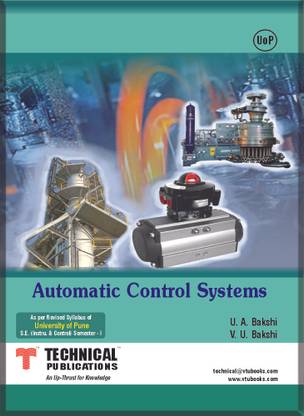
Automatic Control Systems for Pune University 1st Edition (English, Undefined, Bakshi U. A.)
- Language: English
- Binding: Undefined
- Publisher: Technical Publications
- Genre: Education
- ISBN: 9788184316766, 8184316763
- Edition: 1st, 2009
- Pages: 764
Table of Contents
Control Systems
Brief classification of control systems : Open loop v/s closed loop, Feedback v/s feedforward, Linear v/s nonlinear, Stable v/s unstable, Time invariant v/s time variant, Causal v/s noncausal (Definitions only), Representation of electrical, mechanical, electromechanical, thermal, pneumatic, hydraulic systems, Force to voltage and force to current analogies.
Transfer Function, Block Diagram Algebra and Signal Flow Graph
Concept of transfer function, Block diagram algebra : Rules of block diagram reduction and determination of overall transfer function, Signal flow graph : Mason gain formula and its use to determine the overall transfer function, Conversion of block diagram to signal flow graph.
Time Domain Analysis of Control Systems
Standard test signals : impulse, step, ramp, sinusoidal, complex exponential, Impulse response of a control system (from transfer function using inverse laplace transform), Concept of pole, zero, Order and type of a control system, First order, second order systems and their response to impulse and step inputs (for second order systems treat undamped, critically damped, Under damped and over damped cases separately), Time domain specifications of first order control systems from step response (first five time constants), Time domain specifications of second order control systems from step response (natural frequency, damping factor, damped frequency, delay time, rise time, peak time, peak overshoot, settling time for 2 % and 5 % settling-derivation is expected), Static error constants (kp, kv, ka, ess), Dynamic error constants.
Stability and Root Locus
Concept of Stability in s Domain : Classification of stability (BIBO stability and asymptotic stability), Pole-zero plots in s domain, Response term contributed by different types of poles, Stability analysis by Hurwitz criterion and Routh array, determination of marginal gain and oscillation frequency using Routh array, Concept of relative stability and its analysis using Routh array.
Root Locus : Definition, Magnitude and angle conditions, Construction rules, Determination of system gain at any point on root locus (from magnitude condition and by graphical method), Root locus of systems with dead time : Concept, approximation of dead time and construction rules.
Frequency Domain Analysis and Stability
Frequency Domain Analysis of Control Systems : Response of control systems to sinusoidal inputs, Frequency domain specifications of a second order system (resonant frequency, resonant peak), Corelation between time domain and frequency domain specifications.
Stability Analysis in Frequency Domain using Bode Plot : Bode Plot : Actual bode plot and asymptotic Bode plot,Concept of gain margin, phase margin and bandwidth, Stability analysis, Bode plot of systems with dead time, Determination of transfer function from asymptotic Bode plot.
Stability and State Space Analysis
Polar Plot and Stability Analysis in Frequency Domain using Nyquist Plot : Polar plot : Concept and construction, Nyquist plot : Mapping theorem, nyquist stability criterion, nyquist plot, special case of Nyquist plot for systems with pole or zero at origin, Stability analysis.
State Space Representation : Advantages of state space representation over classical representation, Terminology of state space (State, state variables, state equations, state space), Obtaining state model from transfer function by direct ( Companion I and II i.e. controllable canonical and observable canonical forms), Parallel and cascade decomposition, Conversion of state model to transfer function.
| Imprint |
|
| Publication Year |
|
| Book Type |
|
- 5★
- 4★
- 3★
- 2★
- 1★
- 1
- 1
- 0
- 0
- 0

Fabulous!
Gautam Kumar
Certified Buyer, Rishikhesh
Dec, 2017