

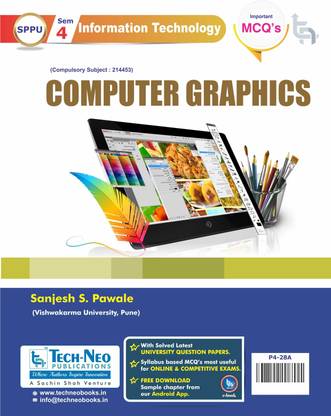
Computer Graphics (Includes Typical MCQ's) For SPPU Sem 4 Information Technology Course Code : 214453 2019 Course (Hardcover, Prof. Sanjesh S. Pawale)
Price: Not Available
Currently Unavailable
Highlights
- Author: Prof. Sanjesh S. Pawale
- 320 Pages
- Language: English
- Publisher: Tech-Neo Publications
Description
COURSE CONTENTS
Unit I : Computer Graphics Basic, OpenGL and Line, Circle Drawing 06 hrs
Introduction CG : Introduction to computer graphics, basics of graphics systems, raster and random scan, basic
display processor
OpenGL – Introduction – Graphics function, OpenGL Interface, primitives and attributes, Control functions,
programming events.Line Drawing : DDA Line drawing algorithm, Bresenham Line drawing algorithm
Circle Drawing : Bresenham circle drawing algorithm.
Character Generation: Stroke principle, starburst principle, bitmap method. Introduction to aliasing and anti-aliasing.
(Refer Chapters 1 and 2)
Case Study Computer-generated imagery (CGI)
Mapping of Course Outcomes for Unit I CO1
Unit II : Polygons, 2D Transformations 06 hrs
Polygons : Polygons and its types, inside test, Polygon filling methods: Seed Fill – Flood fill and Boundary Fill, Scanline
Fill algorithms,
2D Transformations : Translation, Scaling, Rotation, Reflection and Shearing, Matrix representation and
homogeneous coordinate system, composite transformations. (Refer Chapters 3 and 4)
Case Study Transformation of an Object in Computer Graphics: Mathematical Matrix Theory
Mapping of Course
Outcomes for Unit II CO2
Unit III : Windowing, Clipping,3D Transformation, Projections 06 hrs
Windowing : Concept of window and viewport, viewing transformations
Line Clipping : Cohen Sutherland method of line clipping
Polygon Clipping : Sutherland Hodgeman method for convex and concave polygon clipping.
3D Transformation : Translation, scaling, rotation about X, Y, Z & arbitrary axis, and reflection about XY, YZ, XZ &
arbitrary plane.
Projections : Types of projections- Parallel, Perspective
Parallel : oblique – Cavalier, Cabinet, Orthographic – isometric, diametric, trimetric
Perspective : vanishing points as 1 point, 2 point and 3 point. (Refer Chapters 5 and 6)
Case Study 3D Rendering and Modeling
Mapping of Course Outcomes for Unit III CO2 & CO3
Unit IV : Segments, Illumination models, colour models and shading 06 hrs
Segments : Introduction, Segment table, segment creation, closing, deleting, renaming, and visibility.
Illumination models : Light sources, ambient light, diffuse light, specular reflection, the Phong model, combined
diffuse and specular reflections with multiple light sources.
Color Models : CIE Chromaticity Diagram, Color Gamut, RGB, CMY, YCbCr,HSVcolor models.
Shading Algorithms : Constant intensity shading, Halftone, Gourand and Phong Shading. (Refer Chapters 7 and 8)
Case Study Best practices in Day lighting& Passive Systems for
Smaller Commercial Buildings
Mapping of Course Outcomes for Unit IV CO4
Unit V : Curves, fractals and Animation 06 hrs
Curves : Introduction, interpolation and approximation, Spline Interpolation Methods – hermite interpolation, Bezier
curves, B-Splines.
Fractals : Introduction, Classification, fractal Dimension, Fractal dimension and surfaces, Hilbert curve, Koch Curve.Animation : Basics of animation, types of animation, principles of animation, design of animation sequences,
animation languages, key frame, morphing, motion specification.
Methods of controlling animation, frame-by-frame animation techniques, real-time animation techniques.
(Refer Chapters 9 and 10)
Case Study 3D Animation services for character expressions.
Mapping of Course Outcomes for Unit V CO4
Unit VI : Virtual Reality 06 hrs
Introduction of Virtual Reality: Fundamental Concept, Three I’s of virtual reality and Classic Components of VR
systems, Applications of VR systems.
Multiple Modals of Input and Output Interface in Virtual Reality: Input – 3D position Trackers and its types,
Navigation and Manipulation Interfaces, Gesture Interfaces, Graphics Displays – HMD and CAVE, Sound Displays,
Haptic Feedback
Rendering Pipeline: Graphics rendering Pipeline, Haptics Rendering Pipeline Modeling in Virtual Reality: Concepts
of Geometric Modeling, Kinematic Modeling, Physical modeling and Behavior modeling.
(Refer Chapters 11 and 12)
Case Study Virtual reality in aviation and Space travel Training
Mapping of Course Outcomes for Unit VI CO5
Read More
Specifications
| Book |
|
| Author |
|
| Binding |
|
| Publishing Date |
|
| Publisher |
|
| Edition |
|
| Board |
|
| Exam |
|
| Number of Pages |
|
| Language |
|
| Subject |
|
| Age Group |
|
| Specialization |
|
| University |
|
| Genre |
|
| Book Subcategory |
|
| Degree/Diploma |
|
| Term/Year |
|
| Term/Semester |
|
| Author Info |
|
| University/Subject |
|
Be the first to ask about this product
Safe and Secure Payments.Easy returns.100% Authentic products.
Back to top