

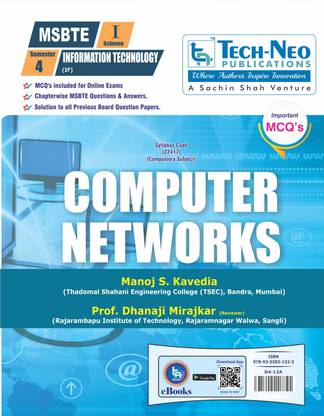
Computer Networks For MSBTE I Scheme Includes Typical MCQ's ( Semester 4 - Information Technology (IF) -22417 ) Academic Year 2018-2019 (Paperback, Er. Manoj S. Kavedia, Prof. Dhanaji Vilas Mirajkar)
Price: Not Available
Currently Unavailable
Highlights
- Author: Er. Manoj S. Kavedia, Prof. Dhanaji Vilas Mirajkar
- 195 Pages
- Language: English
- Publisher: Tech-Neo Publications
Description
Unit I : Fundamentals
of Computer Network
(Refer chapter 1)
1a. Outline benefits of the given
computer network application.
1b. Classify computer network based on
the given criteria.
1c. Describe the steps to share the given
network resource on the specified
operating system.
1d. Select the relevant network
computing model for the given type
of network service with justification.
1e. Elaborate the given feature of NOS.
1.1 Needs, Uses of Computer Networks,
Applications of Computer Networks,
Advantages/Benefits of Computer
Networks : Sharing Information,
Resources, Centralized Management
of resources, Backing up of Data
1.2 Classification of Networks :
Geographical Classification,
Classification Based on Transmission
Technology, Classification Based on
Network Relationships
1.3 Basics of Networks Computing
models : peer-to-peer, client server,
distributed.
1.4 Network Operating System (NOS) : its
types, features.
Unit II : Network
Components and
Topologies
(Refer chapter 2)
2a. Outline the significance of the given
networks component.
2b. Explain the function of the given
network connecting device.
2c. Explain merits/demerits of the
specified type of network topology.
2d. Write the cable/connector/connecting
device requirement to implement the
given network topology.
2e. Describe the procedure to set up the
computer network for the given
requirement.
2.1 Basic Components of Computer
Network : Cables, Host,
Communication, Subnet, NIC.
2.2 Network Devices and their Role :
Repeaters, Hub, Bridge, Switches,
Router and Gateway.
2.3 Wireless Infrastructure Components
: Access point. Clients.
2.4 Network Topologies : Concept,
Significance, Bus, Star, Ring, Tree,
Mesh, Hybrid.
Unit III : Reference
Models for Computer
Networks
(Refer chapter 3)
3a. Describe the significance of the
given design issue for layering in
protocol.
3b. Explain major functions of the
given layer of OSI reference
model.
3c. Explain major functions of the
given layer of TCP/IP protocol
suit.
3d. Write steps to perform sharing
service of the given resource on
the specified operating system.
3e. Describe the procedure to
configure the given type of
computer network.
3.1 Protocol Hierarchies - Layered
Approach
3.2 Interfaces, Services, Protocols and
Packets
3.3 Design Issues for Layering
3.4 OSI Reference Model : Layers and
Their Functions
3.5 TCP/IP Protocol : Layers and their
Functions
3.6 OSI Model Vs. TCP/IP
3.7 Using Basic Network Services : File
Sharing, Print Sharing, Device
SharingUnit IV : TCP/IP
Protocol Suite
(Refer chapter 4)
4a. Explain the salient features of the
given Host-to-Network layer
protocol.
4b. Explain the working of the given
internet layer protocol.
4c. Identify the use of TCP or UDP
at transport layer, based on
functioning of the given
application layer protocol.
4d. Describe function of the given
application layer protocol.
4e. Describe the procedure to
configure the given type of
TCP/IP services.
4.1 Host to Network Layer Protocols :
SLIP, PPP
4.2 Internet Layer Protocols : IP, ARP,
RARP, ICMP
4.3 Transport layer Protocol : TCP,
UDP
4.4 Application Layer Protocol : FTP,
HTTP, SMTP, TELNET, DNS,
BOOTP, DHCP.
Unit V : IP
Addressing
(Refer chapter 5)
5a. Calculate address range of hosts on
each subnet for the given IP address.
5b. Calculate subnet mask for the given
subnet.
5c. Illustrate the method of multicast
operation using given IP address.
5d. Map the given IPv4 address to IPv6
address.
5.1 Addressing : Physical Address,
Logical Address, Port Address
5.2 IP Address : Concept, Notation,
Address Space
5.3 IPv4 Addressing : Classes, Subnet
Mask, Subnetting, Super netting
5.4 Unicast, Multicast, Broadcast
Address, Multicast Operation
5.5 IPv6 Address, Basic Structure
5.6 IPv4 Verses IPv6.
Read More
Specifications
| Book |
|
| Author |
|
| Binding |
|
| Publishing Date |
|
| Publisher |
|
| Edition |
|
| Board |
|
| Exam |
|
| Number of Pages |
|
| Language |
|
| Subject |
|
| Age Group |
|
| Specialization |
|
| University |
|
| Genre |
|
| Book Subcategory |
|
| Degree/Diploma |
|
| Term/Year |
|
| Term/Semester |
|
| Author Info |
|
| University/Subject |
|
Be the first to ask about this product
Safe and Secure Payments.Easy returns.100% Authentic products.
Back to top