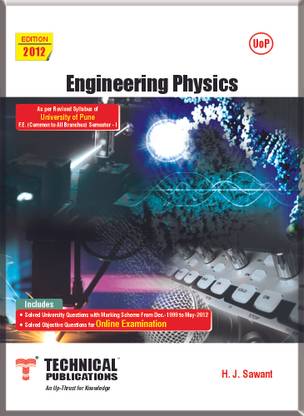
Interference - Diffraction and its Engineering Application
Interference
Introduction, Concept of thin film, Interference due to thin films of uniform thickness (with derivation), Interference due to wedge shaped thin films (qualitative), Fringe width (with derivation), Formation of colors in thin films, Newton's rings, Its applications
i) For the determination of wavelength of incident light or radius of curvature of a given plano-convex lens,
ii) For the determination of refractive index of a given liquid, Applications of interference
i) Testing of optical flatness of surfaces,
ii) Thickness of thin film,
iii) Anti-reflection coating.
Diffraction
Diffraction of waves, Classes of diffraction, Fraunhofer diffraction at single slit (geometrical method) Conditions for maxima and minima, Intensity pattern due to single slit, Diffraction at circular aperture, Plane diffraction grating (qualitative only), Conditions for maxima and minima, Intensity pattern, Scattering of light as an application of diffraction (qualitative only).
Sound Engineering
Definitions : Velocity, Frequency, Wavelength, Intensity, Loudness (expression), Timber of sound, Reflection of sound, Echo, Reverberation, Reverberation time, Sabine's formula (qualitative only), Remedies over reverberation absorption of sound, Absorbent materials, Conditions for good acoustics of the building, Noise, Its effect and remedies. Ultrasonics - Production of ultrasonics by piezo-electric and magnetostriction oscillator, Detection of ultrasonics, Engineering applications of ultrasonics (Non-destructive testing, Cavitations, Measurement of gauge).
Polarization and Laser
Polarization
Introduction, Polarization of waves, Polarization of light, Representation of PPL, UPL and partially polarized light, Production of PPL by
i) Reflection,
ii) Refraction (pile of plates),
iii) Selective absorption (dichroism)
iv) Double refraction, Law of Malus, Huygen's theory of double refraction cases of double refraction of crystal cut with the optic axis lying in the plane of incidence and
i) Parallel to surface
ii) Perpendicular surface
iii) Inclined to surface, Retardation plates, QWP, HWP, Optical activity, Specific rotation (qualitative only), Optically active materials, LCD (as an example of polarization).
Laser
Absorption, Spontaneous emission, Requirement for lasing action (Simulated emission, Population inversion, Metastable state, Active medium, Resonant cavity, Pumping) characteristics of laser : Monochromaticity, Coherence, Directionality, Brightness, Various levels of laser systems with examples
i) Two levels laser system : Semiconductor laser,
ii) Three level laser system : Ruby laser
iii) Four level laser system : He-Ne laser.
Applications in industry (Drilling, Welding, Micromachining etc), Medicine (as a surgical tool), Communication (Principle and advantages only), Information technology (Holography - Recording and reconstruction).
Solid State Physics
Band theory in solids, Free electron theory (qualitative) electrical conductivity in conductor and semiconductor, Influence of external factors on conductivity (Temperature, Light and impurity), Fermi energy, Density state (qualitative) concept of effective mass, Electrons and holes, Fermi-Dirac probability distribution function (effect of temperature on Fermi level with graph), Position of Fermi level in intrinsic semiconductor (with derivation) and extrinsic semiconductors, Dependence of Fermi level on temperature and doping concentration (qualitative), Diffusion and drift current (qualitative), Band structure of PN junction diode uder i) Zero bias,
ii) Forward bias,
iii) Reverse bias, Working of transistor (NPN only) on the basis of band diagram, Hall effect (with derivation), Photovoltaic effect working of solar cell on the basis of band diagram and its applications.
Wave Mechanics
Wave particle duality of radiation and matter, De Broglie's concept of matter wave, Expressing de broglie wavelength in terms of kinetic energy and potential, Concept and derivation of group and phase velocity, Group and phase velocity of matter waves, Heisenberg's uncertainty principle, Illustration of it by electron diffraction at single slit, Why an electron cannot exist in the nucleus, Concept of wave function and probability interpretation of , Schrodinger's time independent and dependant wave equations, Applications of Schrodinger's time independent wave equation
i) Particle in I-D rigid box (infinite potential well), Comparison of quantum mechanical and classical mechanical predictions
ii) Particle in 1-D non rigid box (finite potential well-qualitative, results only), Tunneling effect, Example of tunneling effect in tunnel diode and scanning tunneling microscope.
Superconductivity and Physics of nanopartical
Superconductivity
Introduction, to superconductivity, Properties of superconductors (Zero resistance, Meissner effect, Critical fields, Persistent currents), Isotope effect, BCS theory, Type I and Type II Super conductors, Applications (Super conducting magnets, Transmission lines etc.) DC and AC Josephson effect.
Physics of Nano-particles
Introduction, Nanoparticles, Properties of nanoparticles, Optical, Electrical (Quantum dots, Quantum wires), Magnetic, Structural, Mechanical, Brief introduction to different methods of synthesis of nanoparticles such as physical, Chemical, Biological, Mechanical. Synthesis of colloids, Growth of nanoparticles, Synthesis of metal nano-particles by colloidal route, Application of nanotechnology electronics, Energy, Automobiles, Space and defense, Medical, Environmental, Textile, Cosmetics.