

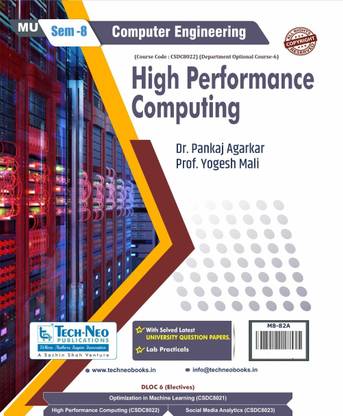
High Performance Computing For MU Semester 8 Computer Engineering Course Code :- (Code :CSDC8022) Academic Year 2022-2023 (Paperback, Dr. Pankaj Agarkar, Prof. Yogesh Mali)
Price: Not Available
Currently Unavailable
Highlights
- Author: Dr. Pankaj Agarkar, Prof. Yogesh Mali
- 220 Pages
- Language: English
- Publisher: Tech-Neo Publications
Description
1 Introduction to Parallel Computing 5
1.1
1.2
1.3
1.4
Parallelism (What, Why, Applications), Levels of parallelism (instruction, transaction, task, thread, memory, function).
Classification Models : Architectural Schemes (Flynn’s, Shore’s, Feng’s, Handler’s).
Memory Access : Distributed Memory, Shared Memory, Hybrid Distributed Shared Memory.
Parallel Architecture : Pipeline Architecture : Arithmetic pipelines, Floating Point, Array Processor. (Refer Chapter 1)
2 Parallel Programming Platform and Algorithm Design 11
2.1
2.2 Parallel Programming Platform : Physical Organization of Parallel Platforms, Communication Costs in Parallel Machines.
Algorithm Design : Preliminaries, Decomposition Techniques, Characteristics of Tasks and Interactions, Mapping Techniques for Load Balancing, Methods for Containing Interaction Overheads, Parallel Algorithm Models. (Refer Chapter 2)
3 Performance Measures 3
Performance Measures : Speedup, execution time, efficiency, cost, scalability, Effect of granularity on performance, Scalability of Parallel Systems, Amdahl’s Law, Gustavson’s Law, Performance Bottlenecks, The Karp Flatt Metric. (Refer Chapter 3)
4 HPC Programming : OpenMP and MPI 10
4.1
4.2
4.3
4.4
4.5
4.6
4.7 HPC Programming : OpenMP
Introduction : Threads, Share memory Architecture, Multi-core processors and Hyperthreading, Fork and join model.
OpenMP directives : #pragma omp parallel, Hello world with openMP, #pragma omp for, #pragma omp for schedule, Serial vs Parallel PI program.
Synchronisation : Introduction, Private vs Shared variables.
Critical section, #pragma omp critical, #pragma omp atomic, #pragma omp barrier, #pragma omp reduction.
HPC Programming : MPI
Introduction : Processes, Multiprocessor programming model, Distributed system programming model, Inter-process communication using message passing : Asynchronous and Synchronous.
MPI Programming : Hello world problem, mpi_initMPI_sendMPI_Recv, Synchronisation : MPI_Barrier
Hybrid (MPI + OpenMP) programming, Hardware requirement, Threads inside Processes, Hybrid Matrix multiplication
Message passing vs Share memory communication : Advantages and disadvantage.
(Refer Chapter 4)
5 Parallel Programming using Accelerators 4
An Overview of GPGPUs, Introduction to CUDA, Introduction to Heterogeneous Computing using OpenCL, An Overview of OpenCL API, Heterogeneous Programming in OpenCL.
(Refer Chapter 5)
6 High Performance Computing in the Cloud 4
Virtualization and Containerization, Parallel Computing Frameworks, Scaling, HPC in the Cloud Use Cases. (Refer Chapter 6)
Read More
Specifications
| Book |
|
| Author |
|
| Binding |
|
| Publishing Date |
|
| Publisher |
|
| Edition |
|
| Board |
|
| Exam |
|
| Standard |
|
| Number of Pages |
|
| Language |
|
| Subject |
|
| Age Group |
|
| Specialization |
|
| University |
|
| Genre |
|
| Book Subcategory |
|
| Degree/Diploma |
|
| Term/Year |
|
| Term/Semester |
|
| Author Info |
|
| University/Subject |
|
Be the first to ask about this product
Safe and Secure Payments.Easy returns.100% Authentic products.




Back to top