

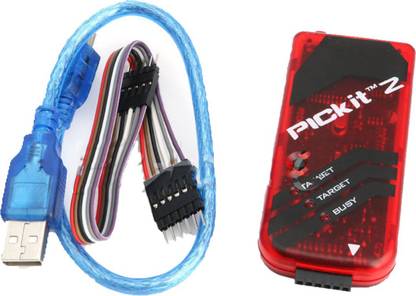
KitsGuru PICKIT2 Microcontroller USB Programmer PIC KIT2 Burner PROGRAM Electronic Components Electronic Hobby Kit
Price: Not Available
Currently Unavailable
Highlights
- Power Source: DC
- Material: Silicone
- Weight: 78
Description
The PICkit2 is a low-cost development tool with an easy to use interface for programming and debugging Microchip’s Flash families of microcontrollers. The full featured Windows® programming interface supports baseline (PIC10F, PIC12F5xx, PIC16F5xx), midrange (PIC12F6xx, PIC16F), PIC18F, PIC24, dsPIC30, dsPIC33, and PIC32 families of 8-bit, 16-bit, and 32-bit microcontrollers, and many Microchip Serial EEPROM products. With Microchip’s powerful MPLAB Integrated Development Environment (IDE) the PICkit2 enables in-circuit debugging on most PIC® microcontrollers. In-Circuit-Debugging runs, halts and single steps the program while the PIC microcontroller is embedded in the application. When halted at a breakpoint, the file registers can be examined and modified.
1. USB 2.0 interface (standard USB-B type connector)
2. Additional 6 pin connector (as ICD2 connector) - very useful, if you have standard RJ11/12 cable for ICSP programming
3. Fully support of PIC10F, PIC12F5xx, PIC16F5xx, PIC12F6xx, PIC16F, PIC18F, PIC24, dsPIC30, dsPIC33, and PIC32 (8-bit, 16- bit and 32-bit) controllers; KEELOQ® HCS devices; EEPROM 11LCxx, 24LCxx, 25LCxx, 93 series; MCP250xx CAN devices
4. function of powering target device from PICkit2 . Power supply voltage can varies in range 2.5V..5V with 0.1V step
5. function of calibration supply voltage
6. "UART Tool" function of USB/UART converter with baudrate up to 38400
7. function of "Logic analyzer"
8. Function «Programmer-To-Go»
9. function "calibrate RC generator" in programmed PIC contoller
10.power supply LED (green)
11 TARGET LED (red) - indicatior of powering target device
12 BUSY LED (yellow) - indicator of PICkit2 BUSY
13.high quality PCB with green mask and white marks
14.fully compatible with Microchip "PICkit2 programmer" software (function of PICkit2 firmware update also supported).
The programmer is fully compatible with wide range of prototype boards (for example PIC-P18, PIC-P28, PIC-P40 - see other my items). 1. Pin 1 -> (MCLR/VPP)
2. Pin 2 -> (VDD/+5V)
3. Pin 3 -> (GND/VSS)
4. Pin 4 -> (DATA)
5. Pin 5 -> (CLOCK)
6. Pin 6 -> (PGM) Normally Not in use
Read More
Specifications
In The Box
|
General
| Brand |
|
| Model Number |
|
| Skillset |
|
| Type |
|
| ROHS Complaint |
|
| Material |
|
| Age Group |
|
Dimensions
| Width |
|
| Height |
|
| Weight |
|
Power Features
| Battery Type |
|
| No Of Batteries |
|
| Battery Size |
|
| Power Source |
|
| Other Power Features |
|
Ratings & Reviews
4.5
★
12 Ratings &
2 Reviews
- 5★
- 4★
- 3★
- 2★
- 1★
- 10
- 0
- 1
- 0
- 1

Be the first to ask about this product
Safe and Secure Payments.Easy returns.100% Authentic products.

Back to top