

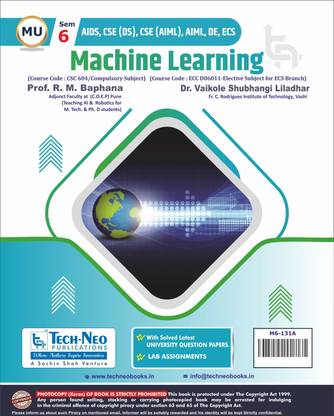
Machine Learning For MU Semester 6 AIDS,CSE(DS)CSE(AIML)AIML,DE (Code :CSC604 Academic Year 2022-2023 (Paperback, Dr. Vaikole Shubhangi L, Prof. R. M. Baphana)
Price: Not Available
Currently Unavailable
Highlights
- Author: Dr. Vaikole Shubhangi L, Prof. R. M. Baphana
- 200 Pages
- Language: English
- Publisher: Tech-Neo Publications
Description
1 Introduction to Machine Learning 6
1.1 Introduction to Machine Learning, Issues in Machine Learning, Application of
Machine Learning, Steps of developing a Machine Learning Application.
1.2 Supervised and Unsupervised Learning : Concepts of Classification, Clustering
and prediction, Training, Testing and validation dataset, cross validation,
overfitting and under fitting of model. (Refer Chapter 1)
1.3 Performance Measures : Measuring Quality of model - Confusion Matrix,
Accuracy, Recall, Precision, Specificity, F1 Score, RMSE.
2 Mathematical Foundation for ML 5
2.1 System of Linear equations, Norms, Inner products, Length of Vector, Distance
between vectors, Orthogonal vectors.
2.2 Symmetric Positive Definite Matrices, Determinant, Trace, Eigenvalues and
vectors, Orthogonal Projections, Diagonalization, SVD and its applications.
(Refer Chapter 2)
3 Linear Models 7
3.1 The least-squares method, Multivariate Linear Regression, Regularised
Regression, Using Least-Squares Regression for classification.
3.2 Support Vector Machines. (Refer Chapter 3)
4 Clustering 4
4.1 Hebbian Learning rule.
4.2 Expectation -Maximization algorithm for clustering. (Refer Chapter 4)
5 Classification Models 12
5.1 Introduction, Fundamental concept, Evolution of Neural Networks, Biological Neuron, Artificial Neural Networks, NN architecture, McCulloch-Pitts Model. Designing a simple network, Non-separable patterns, Perceptron model with Bias. Activation functions, Binary, Bipolar, continuous, Ramp. Limitations of Perceptron.
5.2 Perceptron Learning Rule. Delta Learning Rule (LMS -Widrow Hoff), Multilayer perceptron network. Adjusting weights of hidden layers. Error back propagation algorithm.
5.3 Logistic regression. (Refer Chapter 5)
6 Dimensionality Reduction 5
6.1 Curse of Dimensionality.
6.2 Feature Selection and Feature Extraction.
6.3 Dimensionality Reduction Techniques, Principal Component Analysis.
(Refer Chapter 6)
Total 39
Read More
Specifications
| Book |
|
| Author |
|
| Binding |
|
| Publishing Date |
|
| Publisher |
|
| Edition |
|
| Board |
|
| Exam |
|
| Standard |
|
| Number of Pages |
|
| Language |
|
| Subject |
|
| Age Group |
|
| Specialization |
|
| University |
|
| Genre |
|
| Book Subcategory |
|
| Degree/Diploma |
|
| Term/Year |
|
| Term/Semester |
|
| Author Info |
|
| University/Subject |
|
Be the first to ask about this product
Safe and Secure Payments.Easy returns.100% Authentic products.




Back to top