

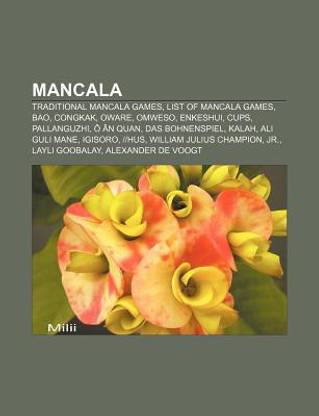
Mancala (English, Paperback, Source Wikipedia)
Price: Not Available
Currently Unavailable
Highlights
- Language: English
- Binding: Paperback
- Publisher: Books LLC, Wiki Series
- ISBN: 9781157038184, 1157038182
- Edition: 2010
- Pages: 30
Description
Chapters: List of Mancala Games, Cups, Ô Ăn Quan, Kalah, Igisoro, William Julius Champion, Jr., Das Bohnenspiel, Oh-Wah-Ree, Ünee Tugalluulakh, Vai Lung Thlan, Giuthi. Source: Wikipedia. Pages: 45. Not illustrated. Free updates online. Purchase includes a free trial membership in the publisher's book club where you can select from more than a million books without charge. Excerpt: Mancala is a family of board games played around the world, sometimes called "sowing" games, or "count-and-capture" games, which describes the game-play. Mancala games play a role in many African and some Asian societies comparable to that of chess in the West, or the game of Go in Eastern Asia. The list of mancala games best known in the Western world includes Kalah and Oware. Other games are Congkak, Omweso, Ünee tugaluulakh, Bao, Sungka and Igisoro. The word manacala comes from the Arabic word naqala meaning literally "to move." There is no one game with the name mancala; instead mancala is a type, or designation, of game. This word is used in Syria, Lebanon, and Egypt, but is not consistently applied to any one game. In the USA, however, "manacala" is often used as a synonym for the game Kalah. Manacala games share a common general gameplay sequence. Players begin by placing a certain number of seeds, prescribed by the variation in use, in each of the pits on the game board. A player may count their stones to plot the game. A turn consists of removing all seeds from a pit, sowing the seeds (placing one in each of the following pits in sequence), and capturing based on the state of board. This leads to the English phrase "Count and Capture" sometimes used to describe the gameplay. Although the details differ greatly, this general sequence applies to all games. Equipment is typically a board, constructed of various materials, with a series of holes arranged in rows, usually two or four. Some games are more often played with holes dug in the earth,...More: http://booksllc.net/?id=20124
Read More
Specifications
Book Details
| Imprint |
|
| Publication Year |
|
| Table of Contents |
|
Dimensions
| Width |
|
| Height |
|
| Length |
|
| Weight |
|
Be the first to ask about this product
Safe and Secure Payments.Easy returns.100% Authentic products.


Back to top