

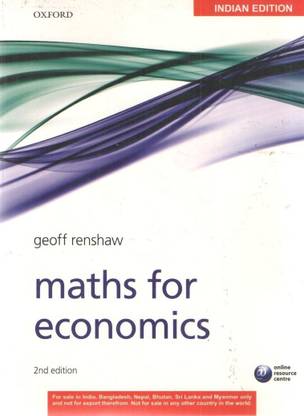
Maths For Economics 2nd Edition 2nd Ed Edition (English, Paperback, Geoff Renshaw)
Price: Not Available
Currently Unavailable
Highlights
- Language: English
- Binding: Paperback
- Publisher: OXFORD UNIVERSITY PRESS-NEW DELHI
- ISBN: 9780199579525, 0199579520
- Edition: 2nd Ed, 2009
- Pages: 662
Description
Maths for Economics provides a solid foundation in mathematical principles and methods for economics and business students.
It aims to build self-confidence in maths, by adopting a user-friendly style and by reinforcing learning at each step through worked examples and test exercises. The book assumes no prior knowledge of mathematics or economics and the author devotes part one to the revision and consolidation of basic skills in arithmetic, algebra and equation solving. From here there is a carefully calculated learning gradient, increasing in mathematical sophistication as the book progresses, designed to ensure a comprehensive understanding of the concepts for any student.
In this latest edition there is a new 4 colour design intended to enhance the pedagogical features in the chapters. Extra material on advanced topics such as Taylor's theorum and comparative statics will be available on the Online Resource Centre.
New to this Edition
Key Features
About the Author
Geoff Renshaw Department of Economics, University of Warwick
Table of Contents
It aims to build self-confidence in maths, by adopting a user-friendly style and by reinforcing learning at each step through worked examples and test exercises. The book assumes no prior knowledge of mathematics or economics and the author devotes part one to the revision and consolidation of basic skills in arithmetic, algebra and equation solving. From here there is a carefully calculated learning gradient, increasing in mathematical sophistication as the book progresses, designed to ensure a comprehensive understanding of the concepts for any student.
In this latest edition there is a new 4 colour design intended to enhance the pedagogical features in the chapters. Extra material on advanced topics such as Taylor's theorum and comparative statics will be available on the Online Resource Centre.
New to this Edition
- Some advanced material, such as Taylor's theorum and comparative statics, will now be available on the Online Resource Centre
- The new edition is 100 pages shorter than the first edition and so will be more appealing to students
Key Features
- Equips students with the necessary skills for applying key mathematical techniques to economics, preparing them for further study
- Assumes no prior knowledge of mathematics or economics to allow flexibility of use
- Underpinned by a gradual learning gradient exploring each concept comprehensively and including numerous examples and exercises at each stage to ensure accessibility and to instil a deep understanding
- Student-friendly 4-colour text design to reflect accessibility
About the Author
Geoff Renshaw Department of Economics, University of Warwick
Table of Contents
- Part I: Foundations
- 1: Arithmetic
- 2: Algebra
- 3: Linear equations
- 4: Quadratic equations
- 5: Some further equations and techniques
- Part II: Optimisation with one independent variable
- 6: Derivatives and differentiation
- 7: Derivatives in action
- 8: Economic applications of functions and derivatives
- 9: Elasticity
- Part III: Mathematics of finance and growth
- 10: Compound growth and present discounted value
- 11: The exponential function and logarithms
- 12: Continuous growth and the natural exponential function
- 13: Derivatives of exponential and logarithmic functions and their applications
- Part IV: Optimisation with two or more independent variables
- 14: Functions of two or more independent variables
- 15: Maximum and minimum values, the total differential and applications
- 16: Constrained maximum and minimum values
- 17: Returns to scale and homogeneous functions; partial elasticities; logarithmic scales; growth accounting
- Part V: Some further topics
- 18: Integration
- 19: Matrix algebra
- 20: Difference and differential equations
Read More
Specifications
Book Details
| Publication Year |
|
Contributors
| Authored By |
|
| Author Info |
|
University Books Details
| Degree/Diploma |
|
| Specialization |
|
| Subject |
|
Dimensions
| Width |
|
Ratings & Reviews
3.8
★
5 Ratings &
2 Reviews
- 5★
- 4★
- 3★
- 2★
- 1★
- 3
- 0
- 0
- 2
- 0
5
Must Read
Excellent Beginners Course... makes your basics perfect. The Calculus, concepts of functions and their application in Economics has been neatly explained. This is a Must read for people who want to begin Economics studies from mathematical angle.
Would like to see more books from this author.
READ MOREWould like to see more books from this author.
Sandeep Rao
Dec, 2013
0
0
Report Abuse
5
Perfect product!
Very helpful for under graduate students of economics.
READ MOREVinay Shankar
Certified Buyer, Varanasi
Aug, 2017
0
0
Report Abuse
Be the first to ask about this product
Safe and Secure Payments.Easy returns.100% Authentic products.




Back to top