

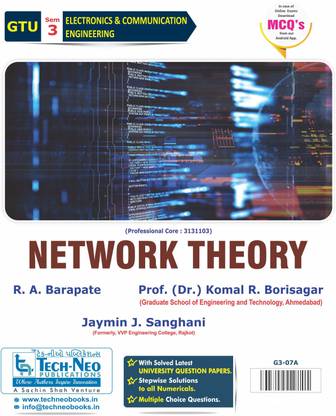
Network Theory For GTU Sem 3 Electronics And Communication Engineering Course Code :3131103 (Hardcover, R. A. Barapate, Prof. (Dr.) Komal R. Borisagar, Prof. Jaymin J. Sanghani)
Price: Not Available
Currently Unavailable
Highlights
- Author: R. A. Barapate, Prof. (Dr.) Komal R. Borisagar, Prof. Jaymin J. Sanghani
- 360 Pages
- Language: English
- Publisher: Tech-Neo Publications
Description
Sr. No. Topics Total Hrs. % Weightage 1. Circuit Variables and Circuit Elements and Sources : E.M.F, Potential and Potential Difference, Current and Current Density, Ideal and Practical Voltage and Current Sources. Conversion from one source into other. Internal Impedance of voltage and current source relative to load. Two-terminal Capacitance – Two-terminal Inductance- Independent and Dependent Electrical Sources –Power and Energy Relations for Twoterminal Elements – Classification of Two-terminal Elements – Multi-terminal Circuit Elements, Dot Convention. (Refer Chapter 1) 3 6 2. Nodal Analysis and Mesh Analysis of resistive Circuits : Nodal Analysis of Circuits Containing Resistors and Independent and Dependent Sources – Source Transformation Theorem for circuits with independent sources – Source Transformation Theorem for circuits with Dependent sources –Nodal Analysis of Circuits Containing Dependent Sources - Mesh Analysis of Circuits with Resistors containing Independent Voltage Sources - Mesh Analysis of Circuits Containing Dependent Sources. (Refer Chapter 2) 5 10 3. Circuit Theorems and Their Applications in Electric Networks : Linearity of a Circuit and Superposition Theorem-Substitution Theorem-Compensation Theorem - Thevenin's Theorem and Norton's Theorem -Determination of Equivalents for Circuits with Dependent Sources -Reciprocity Theorem - Maximum Power Transfer Theorem - Millman's Theorem- Duality Theorem-Duality between Electricity and Magnetism. (Refer Chapter 3) 6 12 4. Time domain response of First order RL and RC circuits : Mathematical preliminaries – Source free response –DC response of first order circuits – Superposition and linearity – Response Classifications – First order RC Op Amp Circuits. (Refer Chapter 4) 4 8 5. Time domain response of Second order linear circuits : Discharging of a Capacitor through an inductor – Source free second order linear networks – second order linear networks with constant inputs. (Refer Chapter 5) 4 8 Sr. No. Topics Total Hrs. % Weightage 6. Initial conditions : Initial conditions in elements, procedure for evaluating initial conditions, Solution of circuit equations by using Initial Conditions. (Refer Chapter 6) 4 8 7. Laplace Transform Analysis and Circuit Applications : Notions of Impedance and Admittance – Manipulation of Impedance and Admittance- Notions of Transfer Function- Equivalent circuits for inductors and capacitors – Nodal and Loop analysis in the s-domain – Switching in RLC circuits- Switched capacitor circuits and conservation of charge. (Refer Chapter 7) 6 10 8. Laplace Transform Analysis and Transfer Function Applications : Poles, Zeros and the s-plane- Classification of Responses – Computation of sinusoidal steady state response for stable networks and systems. (Refer Chapter 8) 5 8 9. Two-Port Networks : One port networks – Two port admittance Parameters (y parameters)– Admittance parameters analysis of terminated two- Port networks - Two port impedance parameters (z-parameters) –Impedance and Gain calculations of terminated two- Port networks modeled by z-parameters – Hybrid parameters (h para)– Inverse Hybrid Parameters (g-para)- Transmission parameters (ABCD parameters)-Scattering parameters(S parameters)-Scattering Transfer parameters(T parameters)–reciprocity-Various Combinations of Two-Port network. (Refer Chapter 9) 8 12 10. Introduction to Network Topology : Linear Oriented Graphs (Connected Graph, Subgraphs and Some Special Subgraphs) - The Incidence Matrix of a Linear Oriented Graph -Kirchhoff's Laws in Incidence Matrix Formulation - Nodal Analysis of Networks – The Circuit Matrix of a Linear Oriented Graph- Kirchhoff's Laws in Fundamental Circuit Matrix Formulation - Loop Analysis of Electrical Networks – ( Loop Analysis of Networks Containing Ideal Dependent Sources- Planar Graphs and Mesh Analysis –Duality)- The Cutset Matrix of a Linear Oriented Graph ( Cut-sets - The All cut-set matrix Qa- Orthogonality relation between Cut-set matrix and Circuit matrix - The Fundamental Cut-set Matrix of - Relation between of , A and Bf) - Kirchhoff's Laws in Fundamental Cut-set formulation - Tie set -Tie set Matrix (F-loop matrix)- Tie set schedule. (Refer Chapter 10) 7 12 11. Introduction to Passive Network Synthesis : Introduction of Hurwitz Polynomial, Positive Real Function (PRF), Elementary Synthesis Procedure. (Refer Chapter 11) 4 6 Total 56
Read More
Specifications
| Book |
|
| Author |
|
| Binding |
|
| Publishing Date |
|
| Publisher |
|
| Edition |
|
| Board |
|
| Number of Pages |
|
| Language |
|
| Subject |
|
| University |
|
| Genre |
|
| Book Subcategory |
|
| Degree/Diploma |
|
| Term/Year |
|
| Term/Semester |
|
| Author Info |
|
| University/Subject |
|
Be the first to ask about this product
Safe and Secure Payments.Easy returns.100% Authentic products.
Back to top