

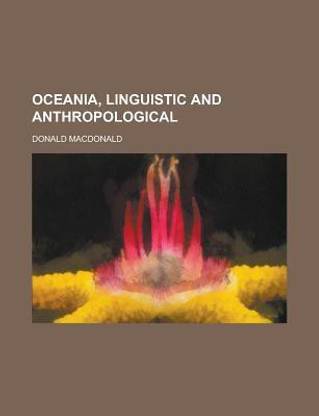
Oceania, Linguistic and Anthropological (English, Paperback, U S Government Donald)
Price: Not Available
Currently Unavailable
Highlights
- Language: English
- Binding: Paperback
- Publisher: Rarebooksclub.com
- ISBN: 9781234336400, 1234336405
- Edition: 2011
- Pages: 48
Description
This historic book may have numerous typos and missing text. Purchasers can usually download a free scanned copy of the original book (without typos) from the publisher. Not indexed. Not illustrated. 1889 edition. Excerpt: ...or looking at (or to) a man. When two nouns come together in My. the first governs the second in the genitive of the construct state, as tanah Jawa, the land of Java. In the other Oc. dialects, Mg., Ef., and Sam., generally a genitive preposition is used, though the construct state is found in all. In Ef. the above would be tano ni Jawa, or tano ngi Jawa, or tano ki Jawa, ni, or ngi, and ki, all forms of the same prep., and ki, My. ka(n). In the Anc. languages, as in the Mod., both constructions are used. CHAPTER X. Nouns, Adjectives, And Verbs. Having considered the pronominal words and the formative and syntactical particles, we now proceed to the other and larger part of the material of the Se.-Oc. languages--the great mass of the stem-words. In Mg. faly (fall) is an adjective signifying pleased, glad (Arb. farih, pleased, glad, v. adj. of fariJia i. he was glad), mifaly 3 (the numbers denote the verb forms above), ifaliana and fifaliana v. subst. of 3, hafaliana v. subst. of faly with article as ha, falifalina v. adj. of faly reduplicated, rnampifaly 5, ampifaliana v. subst. of 5, ampifalina v. adj. of 5, fahafaliana v. subst. of 1 (article as ha), mamalifaly 1 (for manfalifaly, article as n), amalifaliana v. subst. of 1 (see Mg. Dictionary.) The Arb. verb has three forms--i., ii., and iv. In this case the primitive Oc. word is an Anc. verbal adjective (participle). The following is an Anc. verbal substantive (infinitive): --Mg. arahaba a salutation (Arb. marhaba word used as a salutation or in bidding welcome, verb rahuba or rahiba i.), rniarahaba 3, fiarahaba, fiarahabana v. subst. of 3, arahabaina adj. of arahaba p. (primitive). These two words may show that the Oc. primitives or ground-forms are Anc. verbal nouns (substantive...
Read More
Specifications
Book Details
| Imprint |
|
| Publication Year |
|
Dimensions
| Width |
|
| Height |
|
| Length |
|
| Weight |
|
Be the first to ask about this product
Safe and Secure Payments.Easy returns.100% Authentic products.




Back to top