

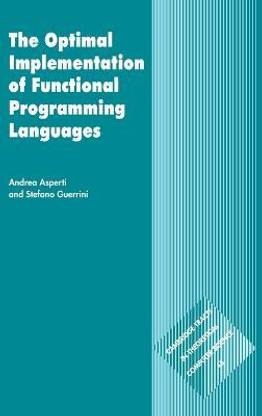
The Optimal Implementation of Functional Programming Languages (English, Hardcover, Asperti Andrea)
Price: Not Available
Currently Unavailable
Highlights
- Language: English
- Binding: Hardcover
- Publisher: Cambridge University Press
- Genre: Computers
- ISBN: 9780521621120, 9780521621120
- Pages: 408
Description
All traditional implementation techniques for functional languages (mostly based on supercombinators, environments or continuations) fail to avoid useless repetition of work; they are not 'optimal' in their implementation of sharing, often causing a catastrophic, exponential explosion in reduction time. Optimal reduction is an innovative graph reduction technique for functional expressions, introduced by Lamping in 1990, that solves the sharing problem. This book, the first in the subject, is a comprehensive account by two of its leading exponents. Practical implementation aspects are fully covered as are the mathematical underpinnings of the subject. The relationship to the pioneering work of Levy and to Girard's more recent Geometry of Interaction are explored; optimal reduction is thereby revealed as a prime example of how a beautiful mathematical theory can lead to practical benefit. The book is essentially self-contained, requiring no more than basic familiarity with functional languages. It will be welcomed by graduate students and research workers in lambda calculus, functional programming or linear logic.
Read More
Specifications
Book Details
| Imprint |
|
Series & Set Details
| Series Name |
|
Dimensions
| Width |
|
| Height |
|
| Length |
|
| Weight |
|
Be the first to ask about this product
Safe and Secure Payments.Easy returns.100% Authentic products.



Back to top