

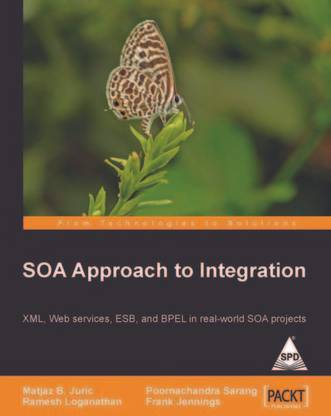
Soa Approach to Integration 0th Edition (English, Paperback, Sarang Poornachandra)
Price: Not Available
Currently Unavailable
Highlights
- Language: English
- Binding: Paperback
- Publisher: Shroff Publishers & Distributors Pvt Ltd
- Genre: Computers
- ISBN: 9788184044553, 8184044550
- Edition: 0th, 2008
- Pages: 384
Description
Integration of applications within a business and between different businesses is becoming more and more important. The needs for up-to-date information that is accessible from almost everywhere and developing e-business solutions particularly business to business require that developers find solutions for integrating diverse, heterogeneous applications, developed in different architectures and programming languages and on different platforms. They have to do this quickly and cost effectively, but still preserve the architecture and deliver robust solutions that are maintainable over time.
Integration is a difficult task. This book focuses on the SOA approach to integration of existing (legacy) applications and newly developed solutions, using modern technologies, particularly web services, XML, ESB, and BPEL. The book shows how to define SOA for integration, what integration patterns to use, which technologies to use, and how to best integrate existing applications with modern e-business solutions. It also shows how to develop web services and BPEL processes, and how to process and manage XML documents from the JEE and .NET platforms. Finally, it also explains how to integrate both platforms using web services and ESBs.
What You Will Learn From This BookHow to design and develop SOA for integration
Integration architecture patterns, principles, and best practices, with focus on the process-centric SOA approach
The role of XML, web services, and ESBs in SOA for integration
The role of service composition and BPEL in integration
J2EE and .NET integration
Why and how to use web services and XML for integrationWho This Book is Written For
This book is for architects and senior developers who are responsible for setting up SOA for integration for applications within the enterprise (intra-enterprise integration) and applications across enterprises (inter-enterprise integration or B2B).
About the Authors
Ramesh Loganathan has 16 years of Systems engineering and R&D management experience in technology-intensive product development organizations including Sonic Software (Technical Director, India Dev Center), Pramati Technologies (VP, Engineering) and Informix (Principal Engineer). Ramesh has full life-cycle experience setting up and managing product development organizations and motivating high-caliber engineering teams. He has strong insight into Systems software, Middleware-technology, Database internals, Internet Architectures, and frameworks. Ramesh has led engineering efforts building software infrastructure products at Pramati and Sonic Software. After a brief engagement with Sonic/Progress, Ramesh is now VP-Middleware Technologies at Pramati, driving the product direction and setting up a new Technology Consulting business around Middleware Systems.
Ramesh has worked with several organizations in India and in the US including IBM, Lever, Compaq, TCS, Informix, and Integra.
Ramesh is an accomplished Technologist and evangelist regularly speaking at workshops and seminars. He is active in Tech fora, JCP, and SPEC organizations. He is a member of several Standards Expert groups including J2EE 1.4 and is a founding member of ebXMLIndia.org and hyd-eclipse.org. Ramesh is actively engaged with academia and researchers and is an Adjunct Faculty member at IIIT-H, teaching two courses on Middleware systems.
Poornachandra Sarang, Ph.D., is CEO of ABCOM Information Systems. He has been a Visiting Professor of Computer Engineering at the University of Notre Dame, USA and is currently a visiting professor for Post-Graduate Computer Science courses at the University of Mumbai. Dr. Sarang provides consulting services to worldwide clients in architecting and designing IT solutions based on Java, CORBA, and Microsoft platforms. A well known and a highly sought-after trainer, Dr. Sarang has conducted several training programs on the latest technologies for several top-notch IT companies. He conducts lectures/seminars on emerging technologies across the world and has made several presentations at international conferences. He has authored/co-authored several books on Java, C++, J2EE, e-Commerce, and .NET.
Zack Lee
Integration is a difficult task. This book focuses on the SOA approach to integration of existing (legacy) applications and newly developed solutions, using modern technologies, particularly web services, XML, ESB, and BPEL. The book shows how to define SOA for integration, what integration patterns to use, which technologies to use, and how to best integrate existing applications with modern e-business solutions. It also shows how to develop web services and BPEL processes, and how to process and manage XML documents from the JEE and .NET platforms. Finally, it also explains how to integrate both platforms using web services and ESBs.
What You Will Learn From This BookHow to design and develop SOA for integration
Integration architecture patterns, principles, and best practices, with focus on the process-centric SOA approach
The role of XML, web services, and ESBs in SOA for integration
The role of service composition and BPEL in integration
J2EE and .NET integration
Why and how to use web services and XML for integrationWho This Book is Written For
This book is for architects and senior developers who are responsible for setting up SOA for integration for applications within the enterprise (intra-enterprise integration) and applications across enterprises (inter-enterprise integration or B2B).
About the Authors
Ramesh Loganathan has 16 years of Systems engineering and R&D management experience in technology-intensive product development organizations including Sonic Software (Technical Director, India Dev Center), Pramati Technologies (VP, Engineering) and Informix (Principal Engineer). Ramesh has full life-cycle experience setting up and managing product development organizations and motivating high-caliber engineering teams. He has strong insight into Systems software, Middleware-technology, Database internals, Internet Architectures, and frameworks. Ramesh has led engineering efforts building software infrastructure products at Pramati and Sonic Software. After a brief engagement with Sonic/Progress, Ramesh is now VP-Middleware Technologies at Pramati, driving the product direction and setting up a new Technology Consulting business around Middleware Systems.
Ramesh has worked with several organizations in India and in the US including IBM, Lever, Compaq, TCS, Informix, and Integra.
Ramesh is an accomplished Technologist and evangelist regularly speaking at workshops and seminars. He is active in Tech fora, JCP, and SPEC organizations. He is a member of several Standards Expert groups including J2EE 1.4 and is a founding member of ebXMLIndia.org and hyd-eclipse.org. Ramesh is actively engaged with academia and researchers and is an Adjunct Faculty member at IIIT-H, teaching two courses on Middleware systems.
Poornachandra Sarang, Ph.D., is CEO of ABCOM Information Systems. He has been a Visiting Professor of Computer Engineering at the University of Notre Dame, USA and is currently a visiting professor for Post-Graduate Computer Science courses at the University of Mumbai. Dr. Sarang provides consulting services to worldwide clients in architecting and designing IT solutions based on Java, CORBA, and Microsoft platforms. A well known and a highly sought-after trainer, Dr. Sarang has conducted several training programs on the latest technologies for several top-notch IT companies. He conducts lectures/seminars on emerging technologies across the world and has made several presentations at international conferences. He has authored/co-authored several books on Java, C++, J2EE, e-Commerce, and .NET.
Zack Lee
Read More
Specifications
| Imprint |
|
| Publication Year |
|
Be the first to ask about this product
Safe and Secure Payments.Easy returns.100% Authentic products.




Back to top