

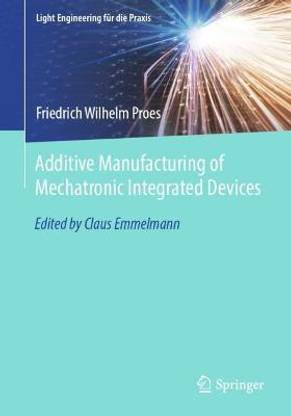
Additive Manufacturing of Mechatronic Integrated Devices (English, Paperback, Proes Friedrich Wilhelm)
Share
Additive Manufacturing of Mechatronic Integrated Devices (English, Paperback, Proes Friedrich Wilhelm)
Be the first to Review this product
₹6,149
₹6,782
9% off
Available offers

T&C
T&C
T&C
T&C
Delivery
Check
Enter pincode
Delivery by15 Feb, Sunday
?
View Details
Highlights
- Language: English
- Binding: Paperback
- Publisher: Springer International Publishing AG
- Genre: Technology & Engineering
- ISBN: 9783031162206
- Pages: 211
Seller

Description
In this dissertation a new process chain for the Additive Manufacturing of Mechatronic Integrated Devices (AMMID) is described, which provides a new way to manufacture 3-dimensional electronic devices based on the selective laser sintering (SLS) process using laser direct structuring (LDS) and metallization. The AMMID process chain meets the rising demand for highly functionalized parts, increasing individualization and shortening development cycles for electronic products. The development for this process chain is based on an extensive literature review that indicates that an SLS-based process chain has great potential to produce 3-dimensional electronic devices with properties and with the future perspective of being suitable for an individualized mass production. The biggest, initial, technical hurdle is an unstable SLS process using a conventional LDS additive. The compound of SLS material and LDS additive was analyzed with DSC, which shows that the additive changes the melting behavior of the polymer by reducing the sintering window. A fine metal powder as an alternative additive affects the sintering window less and enables a stable process. To choose a suitable particle size and content for the metal powder an analytical material model is provided, that predicts the additive particle distribution within the material. This material model deepens the understanding of the activation mechanism during laser activation, provides hands-on information for powder preparation and it is applied for the design of the experiment for the development of the process chain with the new material. Preliminary experiments are conducted along with the insights of the material model, which prove that redeposition is the main activation mechanism during laser activation with fine metal powders. Based on this, the process chain is developed, starting with a determination of a suitable additive content. A suitable material composition of a PA12 powder containing 2 wt.% of a copper powder with a mean particle diameter of 3.5 ?m was identified. With regard to the laser activation, working laser parameters are developed (working parameter set feasible for all used post-process treatments: PRF = 1 kHz, dh = 25 ?m, vs = 25 mm/s, tl = 20ns and P = 1.07 W). In this parameter development it is shown, that only closely located laser spots, enabling interaction of the laser pulses, are capable of activating the surface, while single laser pulses under applied conditions are not. By adding a post-process treatment as additional process step into the process chain, the quality of metallization and the size of design features could be improved. Chemical smoothing resulted in a complete reduction of unwanted metallization on non-activated surfaces. Conductor tracks with the minimal width of 300 ?m could be realized. The process chain could be applied to demonstrator parts such as a drone housing and a PSU panel of an aircraft. Thus, this dissertation has raised the technology readiness level (TRL) from TRL2 to TRL6. Finally, an economic consideration provides insights on the cost structure of parts produced with the AMMID process. A comparison of AMMID and injection molding shows economic viability for small lot sizes, 400 parts in case of the drone housing and 150 parts in case of the PSU panel. Finally, the analysis of the cost structure gives advice which future developments in the process chain have the greatest effect on costs and provides prioritization.
Read More
Specifications
Book Details
| Imprint |
|
Dimensions
| Height |
|
| Length |
|
| Weight |
|
Be the first to ask about this product
Safe and Secure Payments.Easy returns.100% Authentic products.



Back to top