


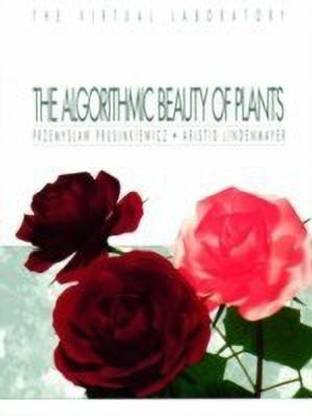
The Algorithmic Beauty of Plants (English, Paperback, Prusinkiewicz Przemyslaw)
Share
The Algorithmic Beauty of Plants (English, Paperback, Prusinkiewicz Przemyslaw)
Be the first to Review this product
₹3,580
₹3,979
10% off
Available offers

T&C
T&C
T&C
T&C
Delivery
Check
Enter pincode
Delivery by5 Feb, Thursday
?
View Details
Highlights
- Language: English
- Binding: Paperback
- Publisher: Springer-Verlag New York Inc.
- Genre: Computers
- ISBN: 9780387946764, 9780387946764
- Pages: 228
Services
- Cash on Delivery available?
Seller
Description
The beauty of plants has attracted the attention of mathematicians for Mathematics centuries. Conspicuous geometric features such as the bilateral sym- and beauty metry of leaves, the rotational symmetry of flowers, and the helical arrangements of scales in pine cones have been studied most exten- sively. This focus is reflected in a quotation from Weyl [159, page 3], "Beauty is bound up with symmetry. " This book explores two other factors that organize plant structures and therefore contribute to their beauty. The first is the elegance and relative simplicity of developmental algorithms, that is, the rules which describe plant development in time. The second is self-similarity, char- acterized by Mandelbrot [95, page 34] as follows: When each piece of a shape is geometrically similar to the whole, both the shape and the cascade that generate it are called self-similar. This corresponds with the biological phenomenon described by Herman, Lindenmayer and Rozenberg [61]: In many growthprocesses of living organisms, especially of plants, regularly repeated appearances of certain multicel- lular structures are readily noticeable. . . . In the case of a compound leaf, for instance, some of the lobes (or leaflets), which are parts of a leaf at an advanced stage, have the same shape as the whole leaf has at an earlier stage. Thus, self-similarity in plants is a result of developmental processes. Growth and By emphasizing the relationship between growth and form, this book form follows a long tradition in biology.
Read More
Specifications
Dimensions
| Height |
|
| Length |
|
| Weight |
|
Series & Set Details
| Series Name |
|
Book Details
| Imprint |
|
Be the first to ask about this product
Safe and Secure Payments.Easy returns.100% Authentic products.




Back to top