

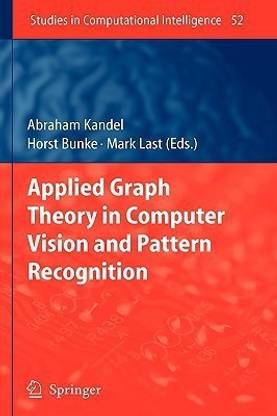
Applied Graph Theory in Computer Vision and Pattern Recognition (English, Hardcover, unknown)
Share
Applied Graph Theory in Computer Vision and Pattern Recognition (English, Hardcover, unknown)
Be the first to Review this product
Special price
₹3,095
₹3,494
11% off
Coupons for you

T&C
Available offers

T&C
T&C
T&C
T&C
Delivery
Check
Enter pincode
Delivery by11 Jan, Sunday
?
View Details
Highlights
- Language: English
- Binding: Hardcover
- Publisher: Springer-Verlag Berlin and Heidelberg GmbH & Co. KG
- Genre: Mathematics
- ISBN: 9783540680192, 9783540680192
- Pages: 266
Services
- Cash on Delivery available?
Seller
Description
Graph theory has strong historical roots in mathematics, especially in topology. Its birth is usually associated with the "four-color problem" posed by Francis Guthrie 1 in 1852, but its real origin probably goes back to the Seven Bridges of Konigsber ? g 2 problem proved by Leonhard Euler in 1736. A computational solution to these two completely different problems could be found after each problem was abstracted to the level of a graph model while ignoring such irrelevant details as country shapes or cross-river distances. In general, a graph is a nonempty set of points (vertices) and the most basic information preserved by any graph structure refers to adjacency relationships (edges) between some pairs of points. In the simplest graphs, edges do not have to hold any attributes, except their endpoints, but in more sophisticated graph structures, edges can be associated with a direction or assigned a label. Graph vertices can be labeled as well. A graph can be represented graphically as a drawing (vertex=dot,edge=arc),but,aslongaseverypairofadjacentpointsstaysconnected by the same edge, the graph vertices can be moved around on a drawing without changing the underlying graph structure. The expressive power of the graph models placing a special emphasis on c- nectivity between objects has made them the models of choice in chemistry, physics, biology, and other ?elds.
Read More
Specifications
Dimensions
| Height |
|
| Length |
|
| Weight |
|
Series & Set Details
| Series Name |
|
Book Details
| Title |
|
| Imprint |
|
| Product Form |
|
| Publisher |
|
| Genre |
|
| Source Type |
|
| ISBN13 |
|
| Book Category |
|
| BISAC Subject Heading |
|
| Book Subcategory |
|
| ISBN10 |
|
| Language |
|
Be the first to ask about this product
Safe and Secure Payments.Easy returns.100% Authentic products.



Back to top