

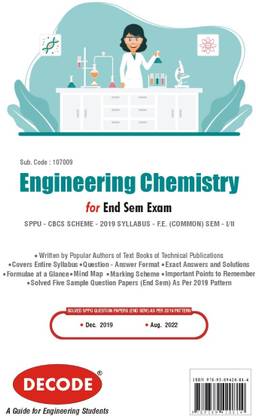
DECODE Engineering Chemistry(END-SEM EXAM)for SPPU 15 Course (FE - I - Common -107009 ) (Paperback, Dr.MANISHA A.Jail, APARNA P.Kulkarni, Dr.Sumit B. Sharma, Dr. Minaz Alvi)
Share
DECODE Engineering Chemistry(END-SEM EXAM)for SPPU 15 Course (FE - I - Common -107009 ) (Paperback, Dr.MANISHA A.Jail, APARNA P.Kulkarni, Dr.Sumit B. Sharma, Dr. Minaz Alvi)
Be the first to Review this product
Special price
₹121
₹170
28% off
Available offers

T&C
T&C
T&C
T&C
Delivery
Check
Enter pincode
Delivery by25 Dec, Thursday
?
View Details
Highlights
- Binding: Paperback
- Publisher: TECHNICAL PUBLICATIONS
- ISBN: 9789389420814, 9389420814
- Edition: THIRD EDITION, 2023
- Pages: 219
Services
- Cash on Delivery available?
Seller

Description
Unit III Engineering Materials A] Speciality polymers : Introduction, preparation, properties and applications of the following polymers : 1. Engineering Thermoplastic : Polycarbonate, 2. Bio-degradable polymers : Poly (hydroxybutyrate-hydroxyvalanate), 3. Conducting Polymer : Polyacetylene, 4. Electroluminescent polymer : Polyphenylenevinylene, 5. Polymer composites : Fiber reinforced plastic (FRP)- Glass reinforced and Carbon reinforced polymer composite [B] Nanomaterials : Introduction, classification of nanomaterials based on dimensions (zero dimensional, one-dimensional, two-dimensional and three-dimensional), structure, properties and applications of graphene and carbon nanotubes, quantum dots (semiconductor nanoparticles). (Chapter-3) Unit IV Fuels Introduction (definition, classification of fuel based on chemical reactions and characteristics of an ideal fuel), Calorific value (CV) : Higher calorific value (HCV) and Lower calorific value (LCV), Determination of Calorific value: Principle, construction and working of Bomb calorimeter and Boy’s gas calorimeter and numericals, Solid fuel : Coal : Analysis of Coal-Proximate and Ultimate analysis, numericals, Liquid fuel: Petroleum: Refining of petroleum /crude oil and composition, boiling range and uses of various fractions, Gaseous fuel : Composition, properties and applications of CNG. Hydrogen gas as a future fuel Alternative fuels : Power alcohol and biodiesel. (Chapter-4) Unit V Spectroscopic Techniques [A] UV-Visible Spectroscopy : Introduction, interaction of electromagnetic radiation with matter, statement of Beer’s law and Lambert’s law, absorption of UV radiation by organic molecule leading to different electronic transitions, terms involved in UV-visible Spectroscopy - chromophore, auxochrome, bathochromic shift, hypsochromic shift, hyperchromic shift and hypochromic shift, Instrumentation and basic principle of single beam spectrophotometer, applications of UV-visible spectroscopy. [B] Infra red Spectroscopy : Introduction, Principle of IR Spectroscopy, types of vibrations: Stretching (symmetric and asymmetric) and bending (scissoring, rocking, wagging and twisting), conditions of absorption of IR radiations, vibration of diatomic and polyatomic molecules. Instrumentation with block diagram. Parts of IR spectrum, fundamental group region, fingerprint region, applications of IR spectroscopy. (Chapter-5) Unit VI Corrosion Science Introduction, Types of corrosion - Dry and Wet corrosion, mechanism of dry corrosion, nature of oxide films and Pilling-Bedworth’s rule, wet corrosion – mechanism: hydrogen evolution and oxygen absorption, galvanic cell corrosion, concentration cell corrosion, Factors influencing rate of corrosion. Methods of corrosion control and prevention: cathodic and anodic protection, metallic coatings and its types, surface preparation, methods to apply metallic coatings-hot dipping, cladding, electroplating, cementation. (Chapter-6)
Read More
Specifications
Book Details
| Publication Year |
|
| Book Type |
|
| Number of Pages |
|
University Books Details
| Degree/Diploma |
|
Additional Features
| Age Group |
|
Frequently Bought Together


Please add at least 1 add-on item to proceed
Be the first to ask about this product
Safe and Secure Payments.Easy returns.100% Authentic products.



Back to top