

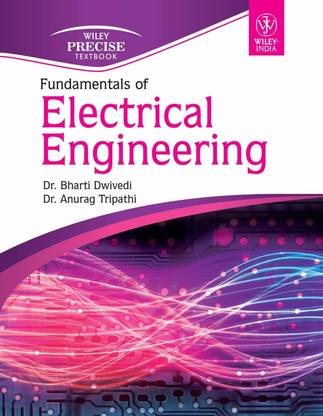

Fundamentals of Electrical Engineering (English, Undefined, Tripathi Anurag)
Fundamentals of Electrical Engineering (English, Undefined, Tripathi Anurag)


- Language: English
- Binding: Undefined
- Publisher: Wiley India Pvt. Ltd
- Genre: Technology & Engineering
- ISBN: 9788126532308, 9788126532308
- Cash on Delivery available?
Fundamentals of Electrical Engineering is a text targeted towards first-year undergraduate students across all streams of Engineering.
This book aims at explaining the basic concepts of electrical circuits in a clear-cut and simplified manner. It begins from the topics which students have already dealt with at the 10+2 level and relates them to the syllabus of a first-year college-level course, thus ensuring a smooth progressive transition from Physics to Electrical Engineering. This book explains methods of solving electrical circuits that are based on first principles but are also described in a stepwise manner.
Key Features
- Provides clear-cut explanation of the basics.
- Assumes no previous knowledge of the field.
- Provides over 125 detailed solved examples in all the chapters to help the student understand and master the concepts.
- All chapters include a summary to recap the concepts discussed.
- Provides over 120 multiple-choice questions and 70 problems with answers to test the students on the material covered in all the chapters.
- The various methods of solving electrical circuits are explained clearly in a step-wise manner with over 350 figures for conceptual clarity.
- Contains three model paper sets based on university exam pattern to help students prepare for exams.
About the Author
Dr. (Mrs.) Bharti Dwivedi, PhD, M.Tech. (IIT Kanpur), is professor and head of the Department of Electrical Engineering, Institute of Engineering and Technology, Lucknow. With over 32 years of teaching experience, Dr. Dwivedi has taught at Government College of Engineering and Technology, Raipur; Government Engineering College, Rewa; and Institute of Engineering and Technology, Lucknow, where she was HOD and then Dean for over 15 years. Besides, she has also worked as Dean of Postgraduate Studies and Research at UPTU, and has been a Convenor/Member of BOS of Electrical Engineering both at UPTU and Lucknow University. With over 60 papers published in various national and international journals and conferences, she has guided many students through their PhDs.
Dr. Anurag Tripathi, PhD (Electric Drives and Control) and M.Tech. (Control and Instrumentation), is assistant professor of Electrical Engineering at Institute of Engineering and Technology, Lucknow. Earlier, he worked with Steel Authority of India for five years. With numerous papers published in several national and international journals, Dr. Tripathi has over 11 years of teaching experience. He cleared IES (written) twice, GATE exam four times, MPPCS (written) and JTO exam.
Table of Contents
1. DC Circuit Analysis and Network Theorems
Learning Objectives
1.1 Concepts of Circuit and Network
1.2 Active and Passive Elements
1.3 Voltage and Current Sources
1.4 Concept of Linearity
1.5 Unilateral and Bilateral Elements
1.6 Source Transformation
1.7 Kirchhoff’s Laws
1.8 Star-Delta Transformation
1.9 Superposition Theorem
1.10 Thevenin’s Theorem
1.11 Norton’s Theorem
1.12 Maximum Power Transfer Theorem
Solved Examples
Summary
Review Questions
Problems
Multiple-Choice Questions
Answers
2. Steady-State Analysis of Single-Phase AC Circuits
Learning Objectives
2.1 AC Fundamentals
2.2 Concept of Phasors
2.3 Power and Power Triangle
2.4 Power Factor
2.5 Analysis of Series Circuits
2.6 Analysis of Parallel Circuits
2.7 Analysis of Series-Parallel Circuits
2.8 Resonance in Series RLC Circuit
Solved Examples
Summary
Review Questions
Problems
Multiple-Choice Questions
Answers
3. Three-Phase AC Circuits
Learning Objectives
3.1 Three-Phase System: Necessity and Advantages
3.2 Meaning of Phase Sequence
3.3 Star and Delta Connections
3.4 Balanced Supply and Balanced Load
3.5 Line and Phase Voltage/Current Relations in Three Phases
3.6 Three-Phase Power and Its Measurement
3.7 Types of Measuring Instruments
3.8 Permanent Magnet Moving Coil Instruments
3.9 Moving Iron Instruments
3.10 Single-Phase Dynamometer-Type Wattmeter
3.11 Induction Type Energy Meter
3.12 Use of Shunts and Multipliers
Solved Examples
Summary
Review Questions
Problems
Multiple-Choice Questions
Answers
4. Power System, Magnetic Circuit and Single-Phase Transformer
Learning Objectives
4.1 Introduction to Power System
4.2 Magnetic Circuit Concepts
4.3 Single-Phase Transformer
Solved Examples
Summary
Review Questions
Problems
Multiple-Choice Questions
Answers
5. Electrical Machines
Learning Objectives
5.1 Principle of Electromechanical Energy Conversion
5.2 DC Machines
5.3 Three-Phase Induction Motor
5.4 Single-Phase Induction Motors
5.5 Three-Phase Synchronous Machines
Summary
Review Questions
Problems
Multiple-Choice Questions
Answers
6. Miscellaneous Topics in Electrical Engineering
Learning Objectives
6.1 Analysis of DC Circuits
6.2 Analysis of AC Circuits
6.3 Analysis of Three-Phase Unbalanced Circuits
6.4 Cathode Ray Oscilloscope and Its Applications
6.5 Measurement of Insulation Resistance
6.6 Magnetic Circuits and Transformers
6.7 Performance of DC and AC Machines
Solved Problems
Summary
Review Questions
Problems
Multiple-Choice Questions
Answers
Model Test Paper 1
Model Test Paper 2
Model Test Paper 3
Index
| Imprint |
|
| Series Name |
|
| Specialization |
|
- 5★
- 4★
- 3★
- 2★
- 1★
- 3
- 1
- 0
- 0
- 0