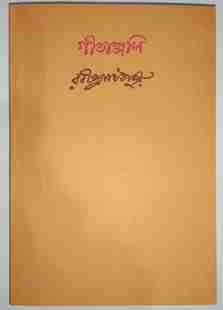
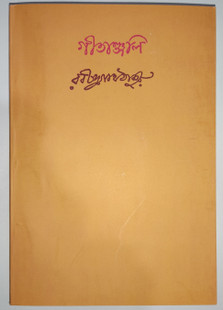
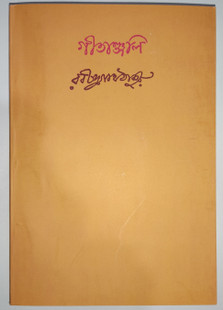
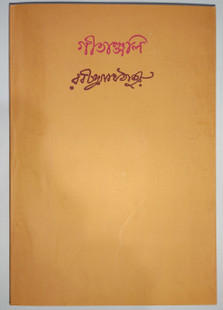
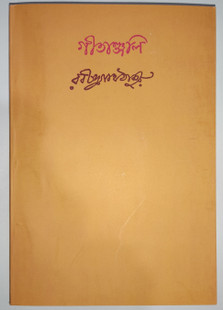
Gitanjali (Text in Bengali) - Gitanjali (English, Hardcover, Tagore Tagore)
Gitanjali is a seminal collection of spiritual and devotional prose poems, originally written in Bengali and later masterfully "transcreated" by Rabindranath Tagore into English, which secured him the 1913 Nobel Prize in Literature. The work's central theme is the loving, intimate union between the individual soul and the divine, often explored through simple metaphors of nature, servitude, and human relationships, drawing heavily on Bhakti and Upanishadic philosophies. Stylistically, it is distinguished by its simple, lyrical, and free-flowing prose poetry, moving away from strict meter and rhyme, influenced by the devotional fervour of Bengali Vaishnava and Sufi mysticism. The English version, titled ‘Gitanjali: Song Offerings’, comprises 103 carefully curated poems, making it a cohesive and powerful expression of profound spiritual yearning.

The profound impact of Gitanjali was officially recognised when Rabindranath Tagore was awarded the Nobel Prize in Literature in 1913. This honour was historically momentous, as it made him the recipient of the prestigious international award. The Swedish Academy specifically cited the "profoundly sensitive, fresh and beautiful verse, by which, with consummate skill, he has made his poetic thought, expressed in his own English words, a part of the literature of the West." This award not only catapulted Tagore to global fame but also shone a powerful spotlight on Indian and Bengali culture and spiritual philosophy.

The genesis of this work lies in the Bengali language, where it was originally published as Gitanjali (meaning Song-offering or handful of songs). However, the version that achieved global acclaim and led to the Nobel Prize was Tagore's own English translation, titled ‘Gitanjali: Song Offerings’. It is crucial to note that this English version is not a literal translation but a poetic transcreation, where Tagore adapted the spirit and rhythm of the original poems, sometimes combining, altering, or omitting parts, to resonate with a Western audience. The success of the English version is therefore a testament not only to his original genius in Bengali but also to his masterful command over English prose poetry.

The overarching focus of the poems is deeply spiritual and devotional. They eschew complex theological arguments in favour of direct, heartfelt expression. The central, unifying theme is the loving union between the individual soul (Jivatman) and the divine (Paramatman or God). The poems often use metaphors of nature, a simple boatman, a king, a lover, or a humble servant to explore this intimate, personal relationship. They express yearning, devotion, surrender, and the ecstatic joy found in the presence of the divine, reflecting the core philosophies of Bhakti and Upanishadic thought.

Gitanjali is distinguished by its unique lyrical, simple, and rhythmic prose poetry. It deliberately moves away from strict meter and rhyme, adopting a free-flowing, meditative quality that is highly accessible yet deeply moving. This style is heavily influenced by the rich traditions of Bengali Vaishnava poetry, which focus on the relationship between Radha and Krishna as a metaphor for the soul and God. Furthermore, the mystical search for the Beloved evident in the poems bears a strong resemblance to the traditions of Sufi mysticism, emphasising a direct, personal, and emotional path to the divine.

The English Gitanjali collection contains 103 prose poems. While the Bengali original, Gitanjali, had 157 songs, the English selection is a curated anthology. Most of the 103 poems are translated or derived from the 157 poems of the Bengali Gitanjali, but Tagore also included translations of a number of poems from his other major works, such as Naivedya and Kheya, to complete the thematic arc and flow of the English volume. This careful structuring contributes to the collection's seamless and powerful impact as a single, coherent devotional work.
| Title |
|
| Imprint |
|
| Publication Year |
|
| Number of Pages |
|
| Product Form |
|
| Publisher |
|
| Alternative Title |
|
| Genre |
|
| ISBN13 |
|
| Book Category |
|
| BISAC Subject Heading |
|
| Book Subcategory |
|
| Edition |
|
| ISBN10 |
|
| Language |
|
| University |
|