

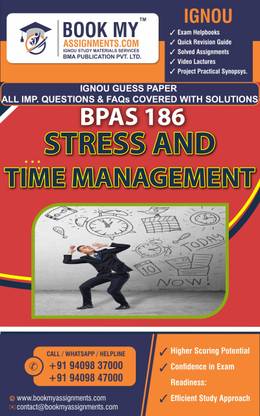
IGNOU BPAS 186 Stress and Time Management | Guess Paper | Important Question Answer | Bachelor of Arts (Gender Studies) (BAGS) (Paperback, BMA Publication)
Share
IGNOU BPAS 186 Stress and Time Management | Guess Paper | Important Question Answer | Bachelor of Arts (Gender Studies) (BAGS) (Paperback, BMA Publication)
Be the first to Review this product
Special price
₹212
₹399
46% off
Available offers

T&C
T&C
T&C
T&C
Delivery
Check
Enter pincode
Delivery by6 Dec, Saturday
?
if ordered before 7:59 AM
View Details
Highlights
- Binding: Paperback
- Publisher: BMA Publication
- ISBN: 9783091213528
- Edition: Latest, 2024
- Pages: 80
Services
- Cash on Delivery available?
Seller

Description
Understanding Stress: Exploring the concept of stress, its sources, and its impact on physical, mental, and emotional well-being.
Types of Stress: Understanding different types of stress, including acute stress, chronic stress, and episodic stress, and their effects on individuals' lives.
Causes of Stress: Identifying common causes of stress, such as work pressure, academic demands, relationship issues, financial problems, and health concerns.
Effects of Stress: Exploring the physical, psychological, and behavioral effects of stress, including anxiety, depression, irritability, fatigue, insomnia, and physical health problems.
Stress Management Techniques: Learning a variety of stress management techniques, including relaxation techniques (e.g., deep breathing, meditation, progressive muscle relaxation), time management, problem-solving skills, and assertiveness training.
Coping Strategies: Understanding different coping strategies for managing stress, including seeking social support, engaging in physical activity, practicing mindfulness, and reframing negative thoughts.
Time Management Skills: Developing effective time management skills, including setting goals, prioritizing tasks, creating schedules and to-do lists, and managing distractions.
Procrastination and Time Wasters: Identifying common obstacles to effective time management, such as procrastination, perfectionism, indecision, and time-wasting activities, and learning strategies to overcome them.
Productivity Techniques: Exploring productivity techniques for maximizing efficiency and effectiveness, such as the Pomodoro Technique, the Eisenhower Matrix, and the 80/20 rule (Pareto Principle).
Read More
Specifications
Book Details
| Publication Year |
|
| Book Type |
|
| Exam |
|
| Number of Pages |
|
| Net Quantity |
|
University Books Details
| Stream |
|
| Degree/Diploma |
|
| Specialization |
|
Additional Features
| Age Group |
|
Be the first to ask about this product
Safe and Secure Payments.Easy returns.100% Authentic products.



Back to top