

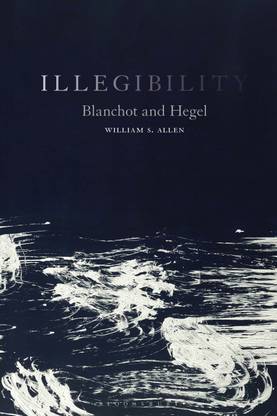
Illegibility (English, Paperback, Allen William S. Dr)
Share
Illegibility (English, Paperback, Allen William S. Dr)
Be the first to Review this product
₹5,052
₹5,445
7% off
Available offers

T&C
T&C
T&C
T&C
Delivery
Check
Enter pincode
Delivery by9 Feb, Monday
?
View Details
Highlights
- Language: English
- Binding: Paperback
- Publisher: Bloomsbury Publishing Plc
- Genre: Literary Criticism
- ISBN: 9781501376788, 1501376780
- Pages: 264
Seller

Description
The philosophical significance of Maurice Blanchot's writings has rarely been in doubt. Specifying the nature and implications of his thinking has proved much less easy, particularly in reference to the key figure of G. W. F. Hegel. Examination reveals that Blanchot's thinking is persistently oriented towards a questioning of the terms of Hegel's thought, while nevertheless remaining within its themes, whichshows how rigorously he studied Hegel's works but also how radical his critique of them became. Equally, it allows for a crucial discussion of the differences between Blanchot's responses to Hegel and those of Jacques Derrida, with the implicit suggestion that in some ways Blanchot's critique of Hegel is more far-reaching than that developed by Derrida. William S. Allen demonstrates those aspects of Hegelian thought that permeate Blanchot's writings and, in turn, develops a detailed three-way analysis of Derrida, Hegel, and Blanchot. The key question around which this analysis develops is that of the relation between thought and language concerning the issue of the infinite and its legibility. Illegibility introduces a new and substantially philosophical account of Blanchot's importance, and also showshow his writings laid the ground for Derrida's workswhile developing their own uniquely challenging response to the problems of post-Hegelian thought.
Read More
Specifications
Dimensions
| Width |
|
| Height |
|
| Length |
|
| Weight |
|
Book Details
| Title |
|
| Imprint |
|
| Product Form |
|
| Publisher |
|
| Genre |
|
| ISBN13 |
|
| Book Category |
|
| BISAC Subject Heading |
|
| Book Subcategory |
|
| ISBN10 |
|
| Language |
|
Contributors
| Author Info |
|
Be the first to ask about this product
Safe and Secure Payments.Easy returns.100% Authentic products.


Back to top