

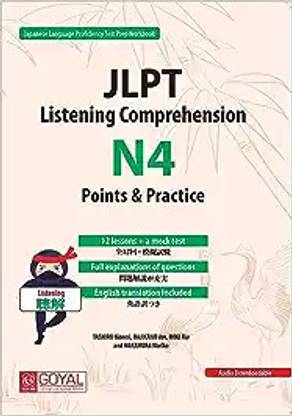
JLPT Listening Comprehension N4 Points & Practice (JLPT Preparation Workbook) Audio Downloadable (Paperback, Tashiro hitomi, HAJIKANO Are, OOKI Rie, NAKAMUR Noriko)
Share
JLPT Listening Comprehension N4 Points & Practice (JLPT Preparation Workbook) Audio Downloadable (Paperback, Tashiro hitomi, HAJIKANO Are, OOKI Rie, NAKAMUR Noriko)
Be the first to Review this product
Special price
₹1,305
₹1,999
34% off
Available offers

T&C
T&C
T&C
T&C
Delivery
Check
Enter pincode
Delivery by21 Dec, Sunday
?
if ordered before 6:59 PM
View Details
Highlights
- Binding: Paperback
- Publisher: Goyal Publishers
- ISBN: 9788119109173
- Edition: New Edition, 2023
- Pages: 135
Services
- Cash on Delivery available?
Seller

Description
The Japanese Language Proficiency Test is a test that measures and certifies the Japanese language proficiency of non-native speakers. As a means of proving Japanese proficiency,
In 2010, the contents of the Japanese Language Proficiency Test (JLPT) underwent a major change as a test to measure "linguistic communication ability to perform tasks" in response to the diversification of test takers and their objectives, as well as the spread of applications. However, it is not easy to learn a vast amount of linguistic knowledge and improve its operational skills. In particular, it is not uncommon for those from non-kanji countries and those who find it difficult to find time to study to find it extremely difficult to pass the exam.
This series is a collection of practice questions designed to help test takers acquire the minimum skills necessary for the exam in a short period of time and bring them closer to passing. We aim to deepen your understanding and gain strength while solving problems on carefully selected learning items.
In this book, you will learn the "solution" of the N4 level.
Features of this book
1. You can practice questions in the same format as the actual exam.
2. Explanations are substantial, and self-study is possible.
3. The basic items that are likely to appear in the exam are summarized as a list, so you can study efficiently.
I often hear from learners that they are not good at listening. One of the reasons is that even if there is something you do not understand while listening to the talk, the audio disappears and it is difficult to check it on the spot. In this book, in order to cultivate listening comprehension, we will solve problems in the same format as the actual Japanese Language Proficiency Test from the beginning, with the spirit of "get used to it rather than learn." While solving the problems, you can efficiently learn
Read More
Specifications
| Publication Year |
|
Manufacturing, Packaging and Import Info
Be the first to ask about this product
Safe and Secure Payments.Easy returns.100% Authentic products.


Back to top