

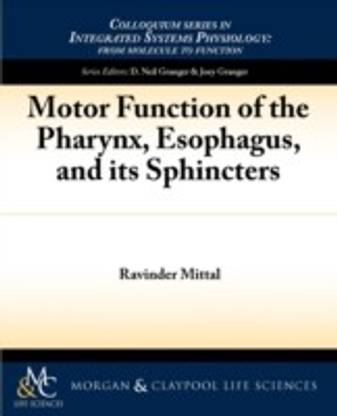
Motor Function of the Pharynx, Esophagus, and its Sphincters (English, Paperback, Mittal Ravi)
Share
Motor Function of the Pharynx, Esophagus, and its Sphincters (English, Paperback, Mittal Ravi)
Be the first to Review this product
₹4,486
₹6,581
31% off
Available offers

T&C
T&C
T&C
T&C
Delivery
Check
Enter pincode
Delivery by23 Jan, Friday
?
View Details
Highlights
- Language: English
- Binding: Paperback
- Publisher: Morgan & Claypool Publishers
- Genre: Science
- ISBN: 9781615043330, 1615043330
- Edition: 2011
- Pages: 84
Seller

Description
Deglutition or a swallow begins as a voluntary act in the oral cavity but proceeds autonomously in the pharynx and esophagus. Bilateral sequenced activation and inhibition of more than 25 pairs of muscles of mouth, pharynx, larynx, and esophagus is required during a swallow. A single swallow elicits peristalsis in the pharynx and esophagus along with relaxation of upper and lower esophageal sphincters. Multiple swallows, at closely spaced time intervals, demonstrate deglutitive inhibition; sphincters remain relaxed during the entire period, but only the last swallow elicits peristalsis. Laryngeal inlet closure or airway protection is very important during swallow. Upper part of the esophagus that includes upper esophageal sphincter is composed of skeletal muscles, middle esophagus is composed of a mixture of skeletal and smooth muscles, and lower esophagus, including lower esophageal sphincter, is composed of smooth muscles. Peristalsis progresses in seamless fashion, despite separate control mechanism, from the skeletal to smooth muscle esophagus. The esophagus's circular and longitudinal muscle layers contract synchronously during peristalsis. Sphincters maintain continuous tone; neuromuscular mechanisms for tonic closure in the upper and lower esophageal sphincters are different. Lower esophageal sphincter transient relaxation, belching mechanism, regurgitation, vomiting, and reflux are mediated via the brain stem.
Read More
Specifications
Book Details
| Imprint |
|
| Publication Year |
|
Dimensions
| Width |
|
| Height |
|
| Length |
|
| Weight |
|
Frequently Bought Together
₹4,486
₹6,581
31% off

Please add at least 1 add-on item to proceed
Be the first to ask about this product
Safe and Secure Payments.Easy returns.100% Authentic products.



Back to top