

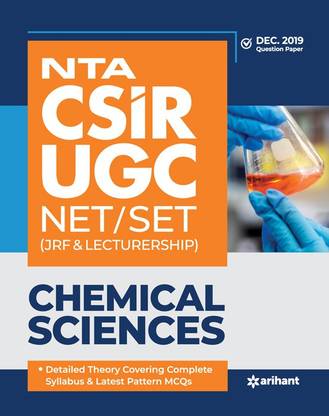
Nta UGC Net Chemical Science 2020 (English, Paperback, Gupta Preeti)
Share
Nta UGC Net Chemical Science 2020 (English, Paperback, Gupta Preeti)
4.4
434 Ratings & 39 ReviewsSpecial price
₹895
Coupons for you

T&C
Available offers

T&C
T&C
T&C
T&C
Delivery
Check
Enter pincode
Delivery by22 Dec, Monday
?
View Details
Highlights
- Language: English
- Binding: Paperback
- Publisher: Arihant Publication
- Genre: Science
- ISBN: 9789324196545, 9789324196545
- Pages: 1450
Services
- Cash on Delivery available?
Seller
Description
A Great teacher is required to be a great learner with ability to synthesize and integrate
knowledge. The Council of Scientific and Industrial Research (CSIR) has entrusted the
responsibility of conducting CSIR-UGC NET in CBT Mode to NTA. CSIR � UGC is a national
level test conducted twice a year (June & December) to determine the eligibility for Junior
Research Fellowship (JRF) and for Lectureship (LS)/ Assistant Professorship� in Indian
Universities and Colleges.�
UGC CSIR NET/SET (JRF & LS) Chemical Sciences is a�well formulated�combination of easy
learning techniques and practice problems containing all the necessary tools and techniques
which assure your success. The entire syllabus of this revised edition has been divided under
39 Chapters giving a complete Chapterwise theory of syllabus accommodated with all the
recent changes. In addition to the theoretical portion the book also concentrates on the practical
part by providing Previous Years� Solved Papers, which are designed according to the pattern
suggested by the council. Questions provided in the book for practice give an idea of the level
examinations that have been conducted and moreover they help to track the level of preparation
is done by the candidates. Packed with Detailed theory and Latest Pattern MCQs for the page,
this book makes a systematic ladder to success in CSIR � UGC NET/SET.
TABLE OF CONTENT
Chemical Periodicity and Chemistry of Main Group Elements, Chemical Bonding and Structure
of Molecules, Acid-Base Chemistry, s-Block Elements, p-Block Elements-I, The p-Block
Elements-II, Noble Gases, d-Block Elements or Transition Elements, Coordination Chemistry,
Inner Transition Elements, Organ metallic Compounds, Analytical Chemistry, Bioinorganic
Chemistry, Coordination Compounds - II, Nuclear Chemistry, Quantum Mechanics or Wave
Mechanics, Atomic Structure and Quantum Theory, Chemical Bonding and Diatomics,
Molecular Symmetry and Group Theory, Molecular Spectroscopy, Thermodynamics, Statistical
Thermodynamics, Electrochemistry, Chemical Kinetics, Surface Chemistry, Solid State, IUPAC
Nomenclature of Organic Compounds, IUPAC Nomenclature of Organic Compounds,
Stereochemistry, Aromaticity, Organic Reaction Mechanism and Reactive Intermediates,
Common Named Reactions and Rearrangements, Organic Transformations and Reagents,
Concept in Organic Synthesis and Asymmetric Synthesis, Pericyclic Reactions, Photochemistry,
Heterocyclic Compounds, Chemistry of Natural Products, Interdisciplinary Topics, Sample
Questions Provided on CSIR website Solved Paper 2016-19].
Read More
Specifications
| Imprint |
|
Manufacturing, Packaging and Import Info
Frequently Bought Together
Please add at least 1 add-on item to proceed
Ratings & Reviews
4.4
★
434 Ratings &
39 Reviews
- 5★
- 4★
- 3★
- 2★
- 1★
- 267
- 111
- 34
- 8
- 14
+ 5
5
Worth every penny
Very nice book to preparation of ugc-net. All syllabus covered.
READ MOREIndra Pal
Certified Buyer, Birbhum
Jul, 2020
6
1
Report Abuse
5
Wonderful
Lots of example.. lots of note.. lots of questions.. I loved it.. and also the packing was too good. No small scratches in my book .. thanks flipkart
READ MOREFlipkart Customer
Certified Buyer, Berhampore
Apr, 2021
2
0
Report Abuse
5
Must buy!
Nice book
READ MOREFlipkart Customer
Certified Buyer, Nandurbar District
Jul, 2020
1
0
Report Abuse
5
Best in the market!
Fast delivery ,very nice book covered wd all d topics ,tq for the free delivery.
READ MORESindhuja N
Certified Buyer, Udupi District
May, 2020
2
0
Report Abuse
5
Classy product
The book is really awesome. This contains hardcore concepts of CSIR-NET, also useful for building strong and crystal clear concepts in chemistry. I think this one is one of the best books to visualize the depth of chemical sciences. Thank you so much Flipkart... 😍
READ MORESayantan Khan
Certified Buyer, Bhadreswar
Jun, 2020
5
4
Report Abuse
4
Value-for-money
I got this book. Very good packed.easyly reached.
Contains so many chapter with syllabus and study material.Question till 2019 with answer not solution.
Thanks
READ MOREContains so many chapter with syllabus and study material.Question till 2019 with answer not solution.
Thanks
Seraj Akhtar
Certified Buyer, Darbhanga District
Jun, 2020
1
0
Report Abuse
5
Terrific
Very much helpful for not only net aspirants but also for IIT JAM aspirants also
READ MORESoumalya Debnath
Certified Buyer, Kshidirpur
Dec, 2020
1
0
Report Abuse
5
Worth every penny
Good content . Good paper quality
READ MOREVISHNU PRASAD P S
Certified Buyer, Nedumangad
Jul, 2020
1
0
Report Abuse
5
Fabulous!
A must for all NET Chemical science aspirants, including good description of individual topics covered in up to date NTA organised CSIR NET. Nice packaging and fast delivery.
READ MOREArka Das
Certified Buyer, Bengaluru
Jun, 2020
1
0
Report Abuse
4
Good choice
Nice product
READ MOREFlipkart Customer
Certified Buyer, Shimoga District
Feb, 2023
0
0
Report Abuse
+
All 39 reviews
Be the first to ask about this product
Safe and Secure Payments.Easy returns.100% Authentic products.
Back to top